Showing posts with label science. Show all posts

Sunday, October 30, 2016

Home automation update

Last year I wrote about my first entry into the field of home automation and the Internet of Things. My first purchase was a combined motion sensor, video camera and Z-Wave hub that can control switches or lights remotely. The device, called Piper, also has sensors for temperature, light, and sound and contains a security siren. I then added some Belkin Wemo LED lights, that required a separate controller and then some OSRAM Lightify LED bulbs and light strips that required their own controller. Ok so now things were getting rather complex with three separate controllers controlling different things. This really reflects the state of the home automation market with many competing standards fighting for dominance; such as: Z-Wave, ZigBee, Hue, Wemo, and even Google and Apple now entering the fray.
   I then came across something called Smartthings that can talk to most of the different automation standards allowing a single controller to automate a wide variety of devices. Of particular interest to me also was that it supports open-source code allowing developers to make their own "SmartApps" for their own needs. which then they can share with the Smartthings community. For example, somebody might make a SmartApp to always ensure that the garage door is closed at sunset. Somebody else might make a SmartApp to turn on the irrigation system at Sunset for one hour, but only if it hasnt rained in the previous day. I now have a Smartthings hub controlling a variety of lights, a motion sensor, garage door opener, and video door bell. My favourite functionality is being told if the garage door is open if Ive left home and being able to remotely close it. The Ring video doorbell that lets me see whos at the front door and talk to them, even when Im not at home, is pretty cool as well.

from The Universal Machine http://universal-machine.blogspot.com/

IFTTT

Put the internet to work for you.

Turn off or edit this Recipe

Read More..

Thursday, October 20, 2016

Computer Science Education Recharged!


A few days ago, I attended the annual SIGCSE (Special Interest Group, Computer Science Education) conference in Atlanta, GA. Google has been a platinum sponsor of SIGCSE for many years now, and the conference provides an opportunity for thousands of CS educators to come together, share ideas and engage in the resurgence of activity and interest in CS education.

Seven years ago, the number of CS majors at the undergraduate level hit an all time low; the number of students taking the Advanced Placement CS exam fell 15% between 2001 and 2007, and the number of college freshmen intending to major in CS plummeted more than 70% during the same period. This was a concern for CS educators, as advancing U.S. students understanding of the principles and practices of computing is critical to developing a globally competitive workforce for the 21st century.

Since 2007, though, many significant things have happened. First, a commission of ten secondary and higher education faculty came together to design a new Advanced Placement CS course called CS Principles. This reinvention of AP CS not only introduces students to programming, but also gives them an understanding of the fundamental concepts of computing, its breadth of application and its potential for transforming the world. Additionally, since 2007 the Computer Science Teachers Association (CSTA), a community that plays a key role in professional development, CS standards definition (another critical stake in the ground), and scaling of the new AP CS, has grown to 16,000+ members.

Finally, late last year, code.org launched Hour of Code with over 29 million students participating, which is an unprecedented scale in CS education. This event raised awareness and provided enormous opportunity for follow-on with teachers and students who realized that coding is not only accessible, but fun. Their next step is to scale Exploring Computer Science this fall to 30 school districts (and counting) including some of the biggest districts in the country, in addition to developing K-5 and middle school curriculum.

Last week at SIGCSE, Google had an opportunity to present two new programs and a transition of an existing program:

  • CS First is a pilot program in South Carolina introducing students to CS in a social, collaborative after-school environment. The focus is on raising awareness and helping students understand their potential in the field.
  • Engage CS Edu will provide curriculum resources for introductory CS1/CS2 courses that are engaging to both women and men.
  • CS4HS continues to experiment this year with online professional development opportunities for teachers. We still support face-to-face CS4HS workshops, but given the success of our MOOC experiments last year, we’d like to continue to see how we might scale to more and more teachers.

The growth in awareness and activity in CS education over the past two years has been amazing and it continues to grow rapidly, thanks to the hard work of many. Google is proud to work with the many organizations in CS education to support and scale their work, through programs and funding. We strive to develop new programs where there are gaps, utilizing our technical infrastructure, our experience with scale, and a deep understanding of the potential of CS to transform the world in positive ways. This has been core to Google’s philosophy since we started 16 years ago.


Read More..

Monday, October 17, 2016

2014 Google PhD Fellowships Supporting the Future of Computer Science


Nurturing and maintaining strong relations with the academic community is a top priority at Google. Today, we’re announcing the 2014 Google PhD Fellowship recipients. These students, recognized for their incredible creativity, knowledge and skills, represent some of the most outstanding graduate researchers in computer science across the globe. We’re excited to support them, and we extend our warmest congratulations.

The Google PhD Fellowship program supports PhD students in computer science or closely related fields and reflects our commitment to building strong relations with the global academic community. Now in its sixth year, the program covers North America, Europe, China, India and Australia. To date we’ve awarded 193 Fellowships in 72 universities across 17 countries.

As we welcome the 2014 PhD Fellows, we hear from two past recipients, Cynthia Liem and Ian Goodfellow. Cynthia studies at the Delft University of Technology, and was awarded a Fellowship in Multimedia. Ian is about to complete his PhD at the Université de Montréal in Québec, and was awarded a Fellowship in Deep Learning. Recently interviewed on the Google Student blog, they expressed their views on how the Fellowship affected their careers.

Cynthia has combined her dual passions of music and computing to pursue a PhD in music information retrieval. She speaks about the fellowship and her links with Google:

“Through the Google European Doctoral Fellowship, I was assigned a Google mentor who works on topics related to my PhD interests. In my case, this was Dr. Douglas Eck in Mountain View, who is part of Google Research and leads a team focusing on music recommendation. Doug has been encouraging me in several of my academic activities, most notably the initiation of the ACM MIRUM Workshop, which managed to successfully bring music retrieval into the spotlight of the prestigious ACM Multimedia conference.”

Ian is about to start as a research scientist on Jeff Dean’s deep learning infrastructure team. He was also an intern at Google, and contributed to the development of a neural network capable of transcribing the address numbers on houses from Google Street View photos. He describes the connection between this intern project and his PhD study supported by the Fellowship:

“The project I worked on during my internship was the basis for a publication at the International Conference on Learning Representations …. my advisor let me include this paper in my PhD thesis since there was a close connection to the subject area.… I can show that some of the work developed early in the thesis has had a real impact.“

We’re proud to have supported Cynthia, Ian, and all the other recipients of the Google PhD Fellowship. We continue to look forward to working with, and learning from, the academic community with great excitement and high expectations.
Read More..

Monday, September 19, 2016

Google Computer Science Capacity Awards


One of Googles goals is to surface successful strategies that support the expansion of high-quality Computer Science (CS) programs at the undergraduate level. Innovations in teaching and technologies, while additionally ensuring better engagement of women and underrepresented minority students, is necessary in creating inclusive, sustainable, and scalable educational programs.

To address issues arising from the dramatic increase in undergraduate CS enrollments, we recently launched the Computer Science Capacity Awards program. For this three-year program, select educational institutions were invited to contribute proposals for innovative, inclusive, and sustainable approaches to address current scaling issues in university CS educational programs.

Today, after an extensive proposal review process, we are pleased to announce the recipients of the Capacity Awards program:

Carnegie Mellon University - Professor Jacobo Carrasquel
Alternate Instructional Model for Introductory Computer Science Classes
CMU will develop a new instructional model consisting of two optional mini lectures per week given by the instructor, and problem-solving sessions with flexible group meetings that are coordinated by undergraduate and graduate teaching assistants.

Duke University - Professor Jeffrey Forbes
North Carolina State University - Professor Kristy Boyer
University of North Carolina - Professor Ketan Mayer-Patel
RESEARCH TRIANGLE PEER TEACHING FELLOWS: Scalable Evidence-Based Peer Teaching for Improving CS Capacity and Diversity
The project hopes to increase CS retention and diversity by developing a highly scalable, effective, evidence-based peer training program across three universities in the North Carolina Research Triangle.

Mount Holyoke College - Professor Heather Pon-Barry
MaGE (Megas and Gigas Educate): Growing Computer Science Capacity at Mount Holyoke College
Mount Holyoke’s MaGE program includes a plan to grow enrollment in introductory CS courses, particularly for women and other underrepresented groups. The program also includes a plan of action for CS students to educate, mentor, and support others in inclusive ways.

George Mason University - Professor Jeff Offutt
SPARC: Self-PAced Learning increases Retention and Capacity
George Mason University wants to replace the traditional course model for CS-1 and CS-2 with an innovative teaching model of self- paced introductory programming courses. Students will periodically demonstrate competency with practical skills demonstrations similar to those used in martial arts.

Rutgers University - Professor Andrew Tjang
Increasing the Scalability and Diversity in the Face of Large Growth in Computer Science Enrollment
Rutger’s program addresses scalability issues with technology tools, as well as collaborative spaces. It also emphasizes outreach to Rutgers’ women’s college and includes original research on success in CS programs to create new courses that cater to the changing environment.

University of California, Berkeley - Professor John DeNero
Scaling Computer Science through Targeted Engagement
Berkeley’s program plans to increase Software Engineering and UI Design enrollment by 500 total students/year, as well as increase the number of women and underrepresented minority CS majors by a factor of three.

Each of the selected schools brings a unique and innovative approach to addressing current scaling issues, and we are excited to collaborate in developing concrete strategies to develop sustainable and inclusive educational programs. Stay tuned over the coming year, where we will report on program recipients progress and share results with the broader CS education community.
Read More..

Wednesday, September 7, 2016

The Computer Science Pipeline and Diversity Part 2 Some positive signs and looking towards the future


(Cross-posted on the Google for Education Blog)

The disparity between the growing demand for computing professionals and the number of graduates in Computer Science (CS) and Information Technology (IT) has been highlighted in many recent publications. The tiny pipeline of diverse students (women and underrepresented minorities (URMs)) is even more troubling. Some of the factors causing these issues are:
  • The historical lack of STEM (Science, Technology, Engineering and Mathematics) capabilities in our younger students; lack of proficiency has had a substantial impact on the overall number of students pursuing technical careers. (PCAST Stem Ed report, 2010)
  • On the lack of girls in computing, boys often come into computing knowing more than girls because they have been doing it longer. This can cause girls to lose confidence with the perception that computing is a man’s world. Lack of role models, encouragement and relevant curriculum are additional factors that discourage girls’ participation. (Margolis 2003)
  • On the lack of URMs in computing, the best and most enthusiastic minority students are effectively discouraged from pursuing technical careers because of systemic and structural issues in our high schools and communities, and because of unconscious bias of teachers and administrators. (Margolis, 2010)
Over the last 3-4 years, however, we have seen some significant positive signals in STEM education in general, and in CS/IT in particular.
  • Math1 and Science2 results as measured by the National Assessment of Educational Progress (NAEP) have improved slightly since 2009, both in general and for female and minority students.
  • Over the last 10 years, there has been an increase in the number of students earning STEM degrees, but the news on women graduates is not as positive.
“Overall, 40 percent of bachelors degrees earned by men and 29 percent earned by women are now in STEM fields. At the doctoral level, more than half of the degrees earned by men (58 percent) and one-third earned by women (33 percent) are in STEM fields. At the bachelors degree level, though, women are losing ground. Between 2004 and 2014, the share of STEM-related bachelors degrees earned by women decreased in all seven discipline areas: engineering; computer science; earth, atmospheric and ocean sciences; physical sciences; mathematics; biological and agricultural sciences; and social sciences and psychology. The biggest decrease was in computer science, where women now earn 18 percent of bachelors degrees (18 percent). In 2004, women earned nearly a quarter of computer science bachelors degrees, at 23 percent.” - (U.S. News, 2015)
  • There has been a steady growth in investment in education companies, particularly those focused on innovative uses of technology.
  • The number of publications in Google Scholar on STEM education that focus on gender issues or minority students has steadily increased over the last several years.
Results from Google Scholar, using “STEM education minority” and “STEM education gender” as search terms
  • Successful marketing campaigns such as Hour of Code and Made with Code have helped raise awareness on the accessibility and importance of coding, and the diverse career opportunities in CS.
  • There has been growth in developer bootcamps over the last few years, as well as online “learn to code” programs (code.org, CS First, Khan Academy, Codecademy, Blockly Games, PencilCode, etc.), and an increase in opportunities for K12 students to learn coding in their schools. We have also seen non-profits emerge focused specifically on girls and URMs (Technovation, Girls who Code, Black Girls Code, #YesWeCode, etc.)
  • One of the most positive signals has been the growth of graduates in CS over the past few years.
Source: 2013 Taulbee Survey, Computing Research Association
So we are seeing small improvements in K-12 STEM proficiency and undergraduate STEM and CS degrees earned, a significant growth in investment in education innovation, more and more research on the issues of gender and ethnicity in STEM fields and increased opportunities for all students to learn coding skills online, through non-profit programs, through developer boot camps or in their schools.

However, an interesting, and potentially threatening development resulting from this positive momentum is the lack of capacity and faculty in CS departments to handle the increased number of enrollments and majors in CS. Colleges and universities, as a whole, aren’t adequately prepared to handle the surge in CS education demand - Currently there just aren’t enough instructors to teach all the students who want to learn.

This has happened in the past. In the 80’s, with the introduction of the PC, and again during the dot-com boom, interest in CS surged. CS departments managed the load by increasing class sizes as much as they possibly could, and/or they put enrollment caps in place and made CS classes harder. The effect of the former was some faculty left for industry while the effect of the latter was a decrease in the diversity pipeline.

These kinds of caps have two effects which limit access by women and under-represented minorities:
  • First, the students who succeed the most in intro CS are the ones with prior experience.
  • Second, creating these kinds of caps creates a perception of CS as a highly competitive field, which is a deterrent to many students. Those students may not even try to get into CS.”
-(Guzdial, 2014)

If we allow the past to repeat itself, we may again find CS faculty leaving for industry and less diversity students going into the field. In addition, unlike the dot-com boom where interest in CS plummeted with the bust, it’s unlikely we will see a decrease in enrollments, particularly in the introductory CS courses. “CS+X”, which represents the application of CS in other fields, is illustrated by the following sample list of interdisciplinary majors in various universities:
  • Yale: "Computer Science and Psychology is an interdepartmental major..."
  • USC: "B.S in Physics/Computer Science for students with dual interests..."
  • Stanford: "Mathematical and Computational Sciences for students interested in..."
  • Northeastern: "Computer Science/Music Technology dual major for students who want to explore connections between..."
  • Lehigh: "BS in Computer Science and Business integrates..."
  • Dartmouth: "The M.D.-Ph.D. Program in Computational Biology..."
The number of non-major students taking CS courses, particularly the introductory ones, is growing, which makes the capacity issues worse.

At Google, we recently funded a number of universities via our 3X3 award program (3 times the number of students in 3 years), which aims to facilitate innovative, inclusive, and sustainable approaches to address these scaling issues in university CS programs. Our hope is to disseminate and scale the most successful approaches that our university partners develop. A positive development, which was not present when this happened in the past, is the recent innovation in online education and technology. The increase in bandwidth, high-quality content and interactive learning opportunities may help us get ahead of this challenging capacity issue.


1Average mathematics scores for fourth- and eighth-graders in 2013 were 1 point higher than in 2011, and 28 and 22 points higher respectively in comparison to the first assessment year in 1990. Hispanic students made gains in mathematics from 2011 to 2013 at both grades 4 and 8. Fourth- and eighth-grade female students scored higher in mathematics in 2013 than in 2011, but the scores for fourth- and eighth-grade male students did not change significantly over the same period. (Nation’s Report Card)

2The average eighth-grade science score increased two points, from 150 in 2009 to 152 in 2011. Scores also rose among public school students in 16 of 47 states that participated in both 2009 and 2011, and no state showed a decline in science scores from 2009 to 2011. A five-point gain from 2009 to 2011 by Hispanic students was larger than the one-point gain for White students, an improvement that narrowed the score gap between those two groups. Black students scored three points higher in 2011 than in 2009, narrowing the achievement gap with White students. (Nation’s Report Card)
Read More..

Sunday, July 10, 2016

Working Together to Support Computer Science Education


(Cross-posted from the Google for Education blog)

Computer Science (CS) education in K-12 is receiving an increasing amount of attention from media and policy makers. Education groups have been working for years to build the infrastructure needed to support CS both inside and outside the school environment, including standards development and dissemination, models for teacher professional development, research, resources for educators, and the building of peer-driven and peer-supported communities of learning.

At Google, we strive to increase opportunities in CS and be a strong contributor to the community of those seeking to improve CS education through our engagement in research, curriculum resource development and dissemination, professional development of teachers, tools development, and large-scale efforts to engage young women and underrepresented groups in computer science. However, despite these efforts, there are still many challenges to overcome to improve the state of CS education.

For example, many people confuse computer science with education technology (the use of computing to support learning in other disciplines) and computer literacy (a very basic understanding of a limited number of computer applications). This confusion leads to the assumption that computer science education is taking place, when in fact in many schools it is not.

Women and minorities are still underrepresented in computer science education and in the high tech workplace. In her introduction to Jane Margolis’ Stuck in the Shallow End: Education, Race, and Computing, distinguished scientist Shirley Malcolm refers to computer science as “privileged knowledge” to which minority students often have no access. This statement is supported by data from the College Board and the National Center for Women and Information Technology.

Poverty also has a significant but often ignored impact on access to technology and quality computer science education. At present there are more than 16 million U.S. children living in poverty; these children are the least likely to have access to computer science knowledge and tools in their schools and homes.

There are many organizations and programs which focus on CS education, working hard to address these issues, and others. This gives Google the unique opportunity to analyze gaps in existing efforts and apply our resources towards programs that are most needed. In so doing, we hope to help uncover new strategies and create sustainable improvements to CS education.

Achieving systemic and sustained change in K-12 CS education is a complex undertaking that requires strategic support that complements both existing formal school programs and extracurricular education. Google is proud to be a member of the community committed to making tangible improvements to the state of CS education. In future blog posts, we will introduce you so some of the programs and resources that Google has been working on.
Read More..

Monday, July 4, 2016

Doing Data Science with coLaboratory


Building products and making decisions based on data is at the core of what we do at Google. Increasingly common among fields such as journalism and government, this data-driven mindset is changing the way traditionally non-technical organizations do work. In order to bring this approach to even more fields, Google Research is excited to be a partner in the coLaboratory project, a new tool for data science and analysis, designed to make collaborating on data easier.

Created by Google Research, Matthew Turk (creator of the yt visualization package), and the IPython/Jupyter development team, coLaboratory merges successful open source products with Google technologies, enabling multiple people to collaborate directly through simultaneous access and analysis of data. This provides a big improvement over ad-hoc workflows involving emailing documents back and forth.

Setting up an environment for collaborative data analysis can be a hurdle, as requirements vary among different machines and operating systems, and installation errors can be cryptic. The coLaboratory Chrome App addresses this hurdle. One-click installs coLaboratory, IPython, and a large set of popular scientific python libraries (with more on the way). Furthermore, because we use Portable Native Client (PNaCl), coLaboratory runs at native speeds and is secure, allowing new users to start working with IPython faster than ever.

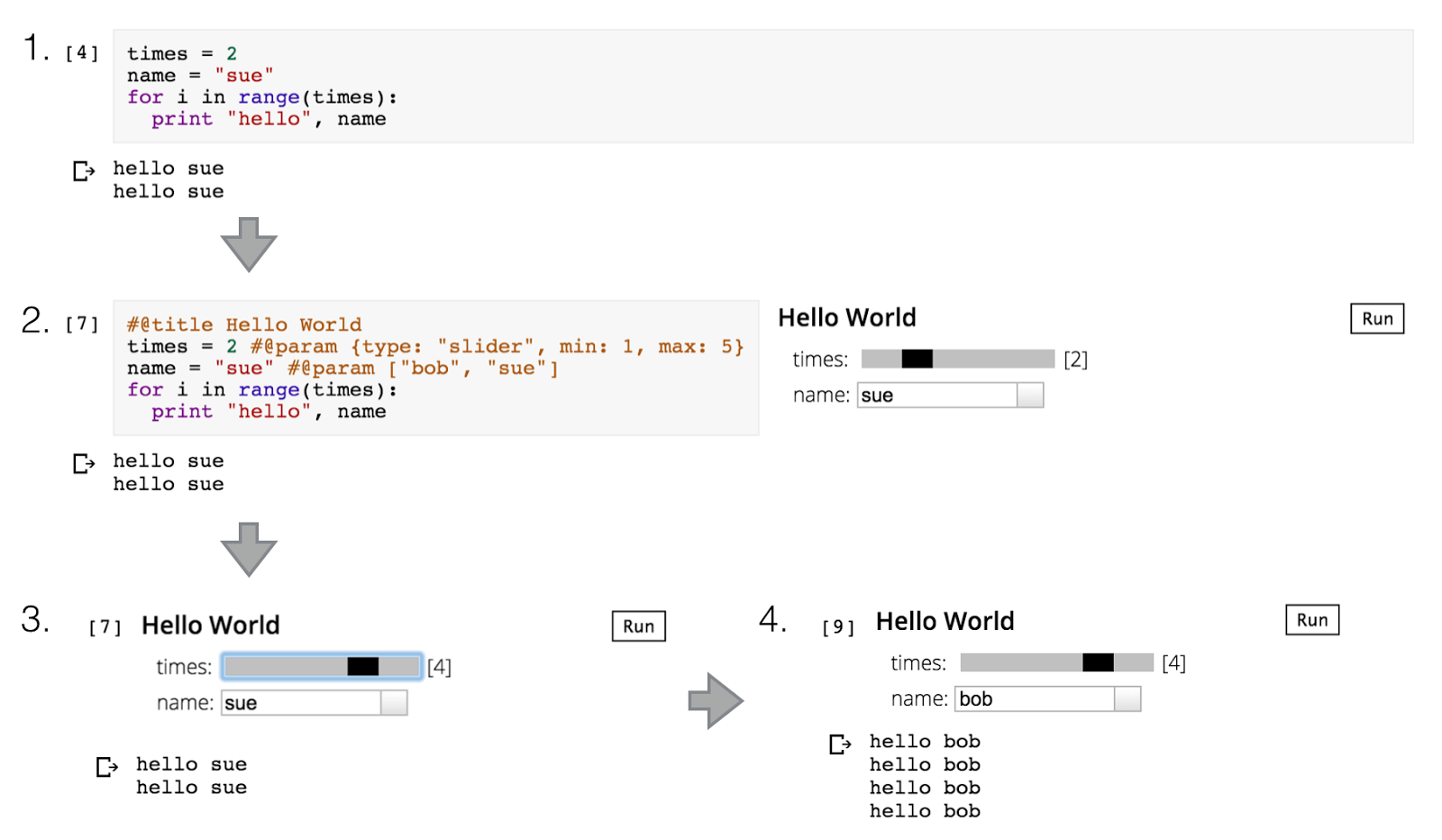
In addition to ease of installation, coLaboratory enables collaboration between people with different skill sets. One example of this would be interactions between programmers who write complex logic in code and non-programmers who are more familiar with GUIs. As shown below, a programmer writes code (step 1) and then annotates that code with simple markup to create an interactive form (step 2). The programmer can then hide the complexity of code to show only the form (step 3), which allows a non-programmer to re-run the code by changing the slider and dropdowns in the form (step 4). This interaction allows programmers to write complex logic in code and allows non-programmers to manipulate that logic through simple GUI hooks.
For more information about this project please see our talks on collaborative data science and zero dependency python. In addition to our external partners in the coLaboratory project, we would like to thank everyone at Google who contributed: the Chromium Native Client team, the Google Drive team, the Open Source team, and the Security team.
Read More..

Thursday, June 23, 2016

The Computer Science Pipeline and Diversity Part 1 How did we get here


(Cross-posted on the Google for Education Blog)

For many years, the Computer Science industry has struggled with a pipeline problem. Since 2009, when the number of undergraduate computer science (CS) graduates hit a low mark, there have been many efforts to increase the supply to meet an ever-increasing demand. Despite these efforts, the projected demand over the next seven years is significant.
Source: 2013 Taulbee Survey, Computing Research Association
Even if we are able to sustain a positive growth in graduation rates over the next 7 years, we will only fill 30-40% of the available jobs.

“By 2022, the computer and mathematical occupations group is expected to yield more than 1.3 million job openings. However, unlike in most occupational groups, more job openings will stem from growth than from the need to replace workers who change occupations or leave the labor force.” -Bureau of Labor Statistics Occupational Projection Report, 2012.

More than 3 in 4 of these 1.3M jobs will require at least a Bachelor’s degree in CS or an Information Technology (IT) area. With our current production of only 16,000 CS undergraduates per year, we are way off the mark. Furthermore, within this too-small pipeline of CS graduates, is an even smaller supply of diverse - women and underrepresented minority (URM) - students. In 2013, only 14% of graduates were women and 20% URM. Why is this lack of representation important?
  • The workforce that creates technology should be representative of the people who use it, or there will be an inherent bias in design and interfaces.
  • If we get women and URMs involved, we will fill more than 30-40% of the projected jobs over the next 7 years.
  • Getting more women and URMs to choose computing occupations will reduce social inequity, since computing occupations are among the fastest-growing and pay the most.
Why are so few students interested in pursuing computing as a career, particularly women and URMs? How did we get here?

One fundamental reason is the lack of STEM (Science, Technology, Engineering and Mathematics) capabilities in our younger students. Over the last several years, international comparisons of K12 students’ performance in science and mathematics place the U.S. in the middle of the ranking or lower. On the National Assessment of Educational Progress, less than one-third of U.S. eighth graders show proficiency in science and mathematics. Lack of proficiency has led to lack of engagement in technical degree programs, which include CS and IT.

“In the United States, about 4% of all bachelor’s degrees awarded in 2008 were in engineering. This compares with about 19% throughout Asia and 31% in China specifically. In computer sciences, the number of bachelor’s and master’s degrees awarded decreased sharply from 2004 to 2007.”  -NSF: Higher Education in Science and Engineering.

The lack of proficiency has had a substantial impact on the overall number of students pursuing technical careers, but there have also been shifts resulting from trends and events in the technology sector that compound the issue. For example, we saw an increase in CS graduates from 1997 to the early 2000’s which reflected the growth of the dot-com bubble. Students, seeing the financial opportunities, moved increasingly toward technical degree programs. This continued until the collapse, after which a steady decrease occurred, perhaps as a result of disillusionment or caution.

Importantly, there are additional factors that are minimizing the diversity of individuals, particularly women, pursuing these fields. It’s important to note that there are no biological or cognitive reasons that justify a gender disparity in individuals participating in computing (Hyde 2006). With similar training and experience, women perform just as well as men in computer-related activities (Margolis 2003). But there can be important differences in reinforced predilections and interests during childhood that affect the diversity of those choosing to pursue computer science .

In general, most young boys build and explore; play with blocks, trains, etc.; and engage in activity and movement. For a typical boy, a computer can be the ultimate toy that allows him to pursue his interests, and this can develop into an intense passion early on. Many girls like to build, play with blocks, etc. too. For the most part, however, girls tend to prefer social interaction. Most girls develop an interest in computing later through social media and YouTubers, girl-focused games, or through math, science and computing courses. They typically do not develop the intense interest in computing at an early age like some boys do – they may never experience that level of interest (Margolis 2003).

Thus, some boys come into computing knowing more than girls because they have been doing it longer. This can cause many girls to lose confidence and drive during adolescence with the perception that technology is a man’s world - Both girls and boys perceive computing to be a largely masculine field (Mercier 2006). Furthermore, there are few role models at home, school or in the media changing the perception that computing is just not for girls. This overall lack of support and encouragement keeps many girls from considering computing as a career. (Google white paper 2014)

In addition, many teachers are oblivious to or support the gender stereotypes by assigning problems and projects that are oriented more toward boys, or are not of interest to girls. This lack of relevant curriculum is important. Many women who have pursued technology as a career cite relevant courses as critical to their decision (Liston 2008).

While gender differences exist with URM groups as well, there are compelling additional factors that affect them. Jane Margolis, a senior researcher at UCLA, did a study in 2000 resulting in the book Stuck in the Shallow End. She and her research group studied three very different high schools in Los Angeles, with different student demographics. The results of the study show that across all three schools, minority students do not get the same opportunities. While all of the students have access to basic technology courses (word processor, spreadsheet skills, etc.), advanced CS courses are typically only made available to students who, because of opportunities they already have outside school, need it less. Additionally, the best and most enthusiastic minority students can be effectively discouraged because of systemic and structural issues, and belief systems of teachers and administrators. The result is a small, mostly homogeneous group of students have all the opportunities and are introduced to CS, while the rest are relegated to the “shallow end of computing skills”, which perpetuates inequities and keeps minority students from pursuing computing careers.

These are some of the reasons why the pipeline for technical talent is so small and why the diversity pipeline is even smaller. Over the last two years, however, we are starting to see some positive signs.
  • Many students are becoming more aware of the relevance and accessibility of coding through campaigns such as Hour of Code and Made with Code.
  • This increase in awareness has helped to produce a steady increase in CS and IT graduates, and there’s every indication this growth will continue.
  • More opportunities to participate in CS-related activities are becoming available for girls and URMs, such as CS First, Technovation, Girls who Code, Black Girls Code, #YesWeCode, etc.
There’s much more that can be done to reinforce these positive trends, and to get more students of all types to pursue computing as a career. This is important not only to high tech, but is critical for our nation to compete globally. In the next post of this series, we will explore some of the positive steps that have been taken in increasing the diversity of graduates in Computer Science (CS) and Information Technology (IT) fields.
Read More..

Sunday, May 1, 2016

Computer Science Teaching Fellows Starting Up in Charleston SC


Google recently started up an exciting new program to ignite interest in computer science (CS) for K12 kids. Located in our South Carolina data center, the Computer Science Teaching Fellows is a two-year post graduate fellowship for new STEM teachers and CS graduates. The goal is to bring computer science and computational thinking to all children, especially underrepresented minorities and girls, and close the gap between the ever-increasing demand in CS and the inadequate supply. We hope to learn what really works and scale those best practices regionally and then nationally.

The supply of CS majors in the pipeline has been a concern for many years. In 2007, the Computer Science education community was alarmed by the lack of CS majors and enrollments in US colleges and universities.

Source: 2009-2010 CRA Taulbee Survey (http://www.cra.org/resources/)

This prompted the development of several programs and activities to start raising awareness about the demand and opportunities for computer scientists, and to spark the interest of K12 students in CS. For example, the NSF funded curriculum and professional development around the new CS Principles Advanced Placement course. The CSTA published standards for K12 CS and a report on the limited extent to which schools, districts and states provide CS instruction to their students. CS advocacy groups, Computing in the Core and Code.org have played an instrumental role in adding provisions to the reauthorization of the Elementary and Secondary School Act to support CS education. More generally, we have seen innovations in online learning with MOOCs, machine learning to provide personalized learning experiences, and platforms like Khan Academy that allow flipped classrooms.

All of these activities represent a convergence in the CS education space, where existing programs are ready for scale, and technological advancements can support that scale in innovative ways. Our Teaching Fellows will be testing after school programs, classroom curriculum and online CS programs to determine what works and why. They’ll start in the local Charleston area and then spread the best programs and curriculum to South Carolina, Georgia, North Carolina (where we also have large data centers). They are currently preparing programs for the fall semester.

We are very excited about the convergence we are seeing in CS education and the potential to bring many more kids into a field that offers not only great career opportunities but also a shot at really making a difference in the world. We’ll keep you posted on the progress of our Teaching Fellows.


Read More..

Sunday, March 13, 2016

What of STEM Should Be Computer Science


We keep hearing in the media how many job vacancies there are for computer scientists and how the critical shortage is restricting the growth of many companies. Every one is agreed that we need more people with computing skills. This article from code.org provides an interesting insight into this skills shortage and offers some solutions.

from The Universal Machine http://universal-machine.blogspot.com/

IFTTT

Put the internet to work for you.

Turn off or edit this Recipe

Read More..

Monday, February 22, 2016

Helping teachers teach computer science

Posted by Karen Parker, Education Program Manager and Jason Ravitz, Education Evaluation Manager

(Cross-posted on the Google for Education Blog)

Since 2009, Google’s CS4HS (Computer Science for High School) grant program has connected more than 12,000 computer science (CS) teachers with skills and resources to teach CS in fun and relevant ways. An estimated 600,000 students have been impacted by the teachers who have completed CS4HS professional development workshops so far. Through annual grants, nearly 230 colleges and universities have hosted professional development workshops worldwide.

Grantees use the funds to develop CS curriculum and professional development workshops tailored for local middle and high school teachers. These workshops expose teachers to CS curriculum using real-world applications that spark students’ curiosity. As feedback from those teachers rolls in, we want to share some highlights from what we’ve learned so far.

What went well:
  • 89% of participants reported they would recommend their workshop to others
  • 44% more participants reported a “high” or “very high knowledge” of CS after their workshop vs. before
  • More than half of participants said they would use “most” or “all” of the activities or resources presented during their workshop.
  • In 2014 the number of teachers who took part in a CS4HS professional development workshop increased by 50%, primarily due to the funding of multiple MOOCs.

Ways to make a bigger impact:

  • Just 53% of participants said they felt a sense of community among the other workshop participants. Research by Joyce & Showers (2002) and Wiske, Stone, & Levinson (1993) shows that peer-to-peer professional development, along with ongoing support, helps teachers implement new content, retain skills, and create lasting change. We’ll explore new ways to build community among participants as we plan future workshops.
  • 83% of participants reported being Caucasian, which is consistent with the current demographics of CS educators. This indicates a need to increase efforts in diversifying the CS teacher population.
  • Outcome measures show us that the most knowledge gains were among teachers who had no prior experience teaching CS or participating in CS professional development -- a population that made up just 30% of participants. While we see that the workshops are meeting a need, there remains an opportunity to develop materials geared toward more experienced CS teachers while also encouraging more new teachers to participate.

We know there are many challenges to overcome to improve the state of CS teacher professional development. We look forward to sharing new ideas for working in partnership with the CS education community to help address those challenges, in particular by helping more teachers teach computer science.


At the University of Sydney CS4HS workshop teachers are learning how to teach
Computer Science without a computer during a CS Unplugged activity.

Read More..

Tuesday, February 2, 2016

The exploding demand for computer science degrees


The graph above shows the trend in applications for science and engineering degrees at the University of Washington in Seattle over the last few years. As you can clearly see interest in doing computer science is sky rocketing. An excellent article in Geek Wire analyses this trend across a number of universities and compares it to other booms in computer science in the 80s and 90s.  The article goes on to explain that this boom may not be a bubble, like the dot com fuelled boom of the 90s was, since it reflects a growing need for computer science graduates across all sectors. The challenge is how academic institutions satisfy this growing demand.


from The Universal Machine http://universal-machine.blogspot.com/

IFTTT

Put the internet to work for you.

Turn off or edit this Recipe

Read More..
 
Copyright 2009 Information Blog
Powered By Blogger