I came across this intriguing news story the other day about a group of school students from St Thomas of Canterbury College in Christchurch NZ who have made an operating system, called George, that uses games and tests to teach basic literacy and numeracy. The educational OS is designed to run on old (semi-obsolete) computers. Unfortunately, apart from this news story I can find no other information about this at all. It seems they have neglected to make a web page to describe their innovation. It gets more confusing because (news to me) it turns out there used to be an OS called George that ran on International Computers and Tabulators (ICT) mainframe computers in the 1960s. So if anyone reading this has any more information on the (new) George OS please contact me.
from The Universal Machine http://universal-machine.blogspot.com/
Posted by Jeff Dean, Senior Google Fellow, and Rajat Monga, Technical Lead
Deep Learning has had a huge impact on computer science, making it possible to explore new frontiers of research and to develop amazingly useful products that millions of people use every day. Our internal deep learning infrastructure DistBelief, developed in 2011, has allowed Googlers to build ever larger neural networks and scale training to thousands of cores in our datacenters. We’ve used it to demonstrate that concepts like “cat” can be learned from unlabeled YouTube images, to improve speech recognition in the Google app by 25%, and to build image search in Google Photos. DistBelief also trained the Inception model that won Imagenet’s Large Scale Visual Recognition Challenge in 2014, and drove our experiments in automated image captioning as well as DeepDream.
While DistBelief was very successful, it had some limitations. It was narrowly targeted to neural networks, it was difficult to configure, and it was tightly coupled to Google’s internal infrastructure - making it nearly impossible to share research code externally.
Today we’re proud to announce the open source release of TensorFlow -- our second-generation machine learning system, specifically designed to correct these shortcomings. TensorFlow is general, flexible, portable, easy-to-use, and completely open source. We added all this while improving upon DistBelief’s speed, scalability, and production readiness -- in fact, on some benchmarks, TensorFlow is twice as fast as DistBelief (see the whitepaper for details of TensorFlow’s programming model and implementation). TensorFlow has extensive built-in support for deep learning, but is far more general than that -- any computation that you can express as a computational flow graph, you can compute with TensorFlow (see some examples). Any gradient-based machine learning algorithm will benefit from TensorFlow’s auto-differentiation and suite of first-rate optimizers. And it’s easy to express your new ideas in TensorFlow via the flexible Python interface.
Inspecting a model with TensorBoard, the visualization tool
TensorFlow is great for research, but it’s ready for use in real products too. TensorFlow was built from the ground up to be fast, portable, and ready for production service. You can move your idea seamlessly from training on your desktop GPU to running on your mobile phone. And you can get started quickly with powerful machine learning tech by using our state-of-the-art example model architectures. For example, we plan to release our complete, top shelf ImageNet computer vision model on TensorFlow soon.
But the most important thing about TensorFlow is that it’s yours. We’ve open-sourced TensorFlow as a standalone library and associated tools, tutorials, and examples with the Apache 2.0 license so you’re free to use TensorFlow at your institution (no matter where you work).
Our deep learning researchers all use TensorFlow in their experiments. Our engineers use it to infuse Google Search with signals derived from deep neural networks, and to power the magic features of tomorrow. We’ll continue to use TensorFlow to serve machine learning in products, and our research team is committed to sharing TensorFlow implementations of our published ideas. We hope you’ll join us at www.tensorflow.org.
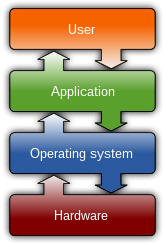
Operating System OS(Operating system), OSs are the backbone software to any computer it is the program that allows evering thing else to be added, it is the first piece of software you install on a newly build computer. OSs as we think of them today did not exist until the early 1960s. There are different types of user the two most common are command line and GUI(Graphical User Interface) command line was big in the 60s and 70s.
The two biggest OSs today are Microsofts Windows OS, and Apples Macintosh OS. One of the first GUIs to hit the market was the Apple lisa. It did not sell very well due to the $10,000 price tag. Then apple came out with the macintosh and it sold well due to the drastic price drop. There are many smaller OSs that are gaining popularity one to note is Linux. Linux is built off of UNIX which is ca command line driven OS. Still used by many large corporations,but not the general public due to its large price tag. This is where linux comes in, linux and its variations which there are too many to list are free and some offer a GUI. Linux is a very popular OS which is one of the few that can act as a server with no 3rd party software.
Best creative commons example i could find.
History of computers Charles Babbage is the man credited with creating the concept of input,storage, processing,and output, when he outlined his idea of the ultimate calculator. The problem with his design was that it was mechanical and vulnerable to mechanical problems like wear. What made computers a viable thing instead of "Thing of fantasy" was the invention of electronic devices. With that we created the vacuum tube, then the transitor that replaced that, and is now the basis for all of our electronics today.