So we have a video from Youtube, download video format but do not format audio. Many mega bytes audio save you a good opportunities for those who want to download format. Assume whatever tips you know.
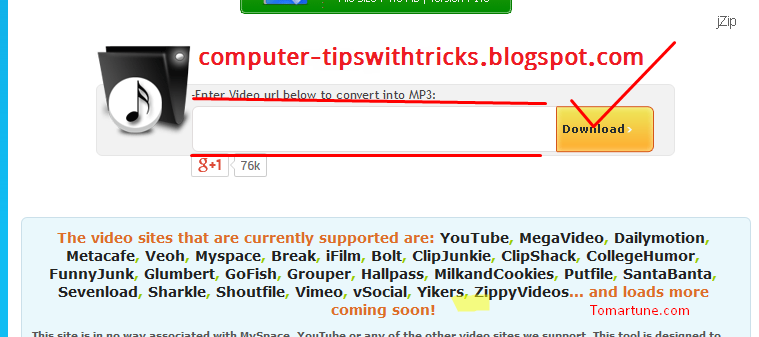
First go to this link Click to download youtube videos in mp3 format, you will see this picture shown bellow-
Then mark the red spot in the box and paste the link to your youtube video and then click download.
Then a few second you will verify the link and download will start automatically.
You can install this by pulling the source from git and running the InstallAUISuite.sh file. Commands to install are below (your user should have sudo priveledges but you dont need to sudo or be root to run the commands unless shown otherwise):
So this is a quick video to demonstrate youtube working fast and easily on the Raspberry Pi without the use of XBMC or gnash. I tried out gnash first which didnt work at all. So then I tried out XBMC and although it is pretty, it is awfully slow so I decided to get youtube to work on my own. The basis of this is really simple. There is a nifty program out there called youtube-dl that can get the media file from the website and download it. Its great because it does it fast and works for many other websites like the daily show and the colbert report. So what I did was basically write a little script that analyzes your input and then gets the proper information from the youtube-dl program without downloading the video, then it sends this http stream to omxplayer to play. It can handle playlists or individual files from multiple websites as well as a bunch of other things.
After that, I started implementing a nice little search feature using C++ and Curl. Im starting to implement a GUI which will essentially look like youtube kind of. Until then I have this nifty search tool, which was essentially my start to the GUI I am currently creating.
If youve ever used XBMCs youtube, you will notice that this is a lot faster, and in my opinion, easier to use and more natural. Plus it only requires a tiny file on your system as opposed to XBMCs massive footprint.
The nice part of having an easy command line program like this is that it can be incorporated into a lot of other things easily. For instance, I have incorporated it into my voicecommand script as shown in the video.
The source code can be found here. To install see the top.
Sources: This post for using axel with the youtube-dl. This page for the youtube-dl source and documentation.
“If it looks like a duck, swims like a duck, and quacks like a duck, then it probably is a duck.”
The “duck test”.
Performance of machine learning algorithms, supervised or unsupervised, is often significantly enhanced when a variety of feature families, or multiple views of the data, are available. For example, in the case of web pages, one feature family can be based on the words appearing on the page, and another can be based on the URLs and related connectivity properties. Similarly, videos contain both audio and visual signals where in turn each modality is analyzed in a variety of ways. For instance, the visual stream can be analyzed based on the color and edge distribution, texture, motion, object types, and so on. YouTube videos are also associated with textual information (title, tags, comments, etc.). Each feature family complements others in providing predictive signals to accomplish a prediction or classification task, for example, in automatically classifying videos into subject areas such as sports, music, comedy, games, and so on.
We have released a dataset of over 100k feature vectors extracted from public YouTube videos. These videos are labeled by one of 30 classes, each class corresponding to a video game (with some amount of class noise): each video shows a gameplay of a video game, for teaching purposes for example. Each instance (video) is described by three feature families (textual, visual, and auditory), and each family is broken into subfamilies yielding up to 13 feature types per instance. Neither video identities nor class identities are released.
We hope that this dataset will be valuable for research on a variety of multiview related machine learning topics, including multiview clustering, co-training, active learning, classifier fusion and ensembles.
The data and more information can be obtained from the UCI machine learning repository (multiview video dataset), or from here.